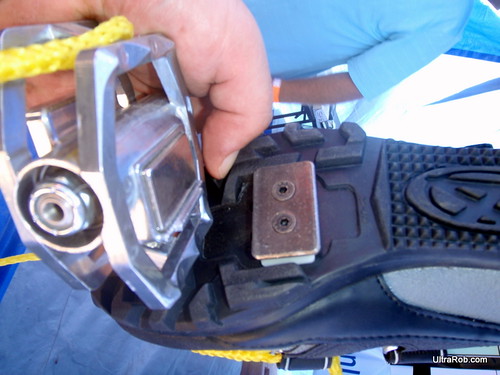
The magnetic plates will fit "most SP - ISIS - two screw cleat mount" cycling shoes. This contrasts with Mavic's EZ Ride Magnetic Pedals, which requires a special shoe that matches the pedal.

There are six models of the shoe (3 designs for men and women), but I'm curious how well this proprietary shoe plus pedal will work out for Mavic, and it's Yet Another Shoe (in several sizes) that the bike stores have to keep in stock if they want to sell this pedal.
While recent advances in strong magnets make magnetic pedal retention more practical, the idea has been around since the 19th Century. Henry Tudor first patented his magnetic bike pedal in 1896.

"The object of my invention is to avoid the use of toe-clips or other devices by which to prevent the foot from slipping off or disengaging from the pedal," says Tudor's US patent 588,038. His patent specifies a magnetic plate on the pedal, and either "soft iron" or another magnet in the shoe to "hold the foot in a fixed position and prevent any change or disengagement from the pedal which might occur arising from high speed or due to shocks or jolts owing to irregularities in the surface of the road."
Nearly 100 years later, patent 5473963 is granted to James Aeschbach's "Magnetic bicycle pedal foot retainer," which improves on the state of the art by embedding the shoe magnet into the sole of the shoe in a way that's compatible with clipless pedal binding systems of the day.

What do you think? Are modern clipless pedals good enough for you? Or would you like something you can just snap in place without any practice beforehand?


 The eneloop bike is a 26-inch, three-speed regenerative, pedal-assist hybrid electric bicycle. As such, riders can propel the eneloop bike under their own power or can engage the bike’s motor and electrical system to pedal in one of three assist modes – standard, power-up or auto – where the front hub-based motor helps the bicycle and rider travel forward.






 when purchased through Amazon.com. New activations only and contract required.
 or the
  , among any of their other phones.
